Major Types of Surgical Implants
Surgical implants can be divided into several major categories.
1. Orthopedic Implants
2. Trauma Implants
3. Joint Replacement Implants
4. Spinal Implants
5. Dental Implants
6. Maxillofacial Implants
Surgical Implant Materials
Material selection is an important part of implant design.
Common implant materials include:
Titanium
Titanium and titanium alloys are widely used in orthopedic and dental implants because of their combination of strength, corrosion resistance, and biocompatibility.
Applications can include:
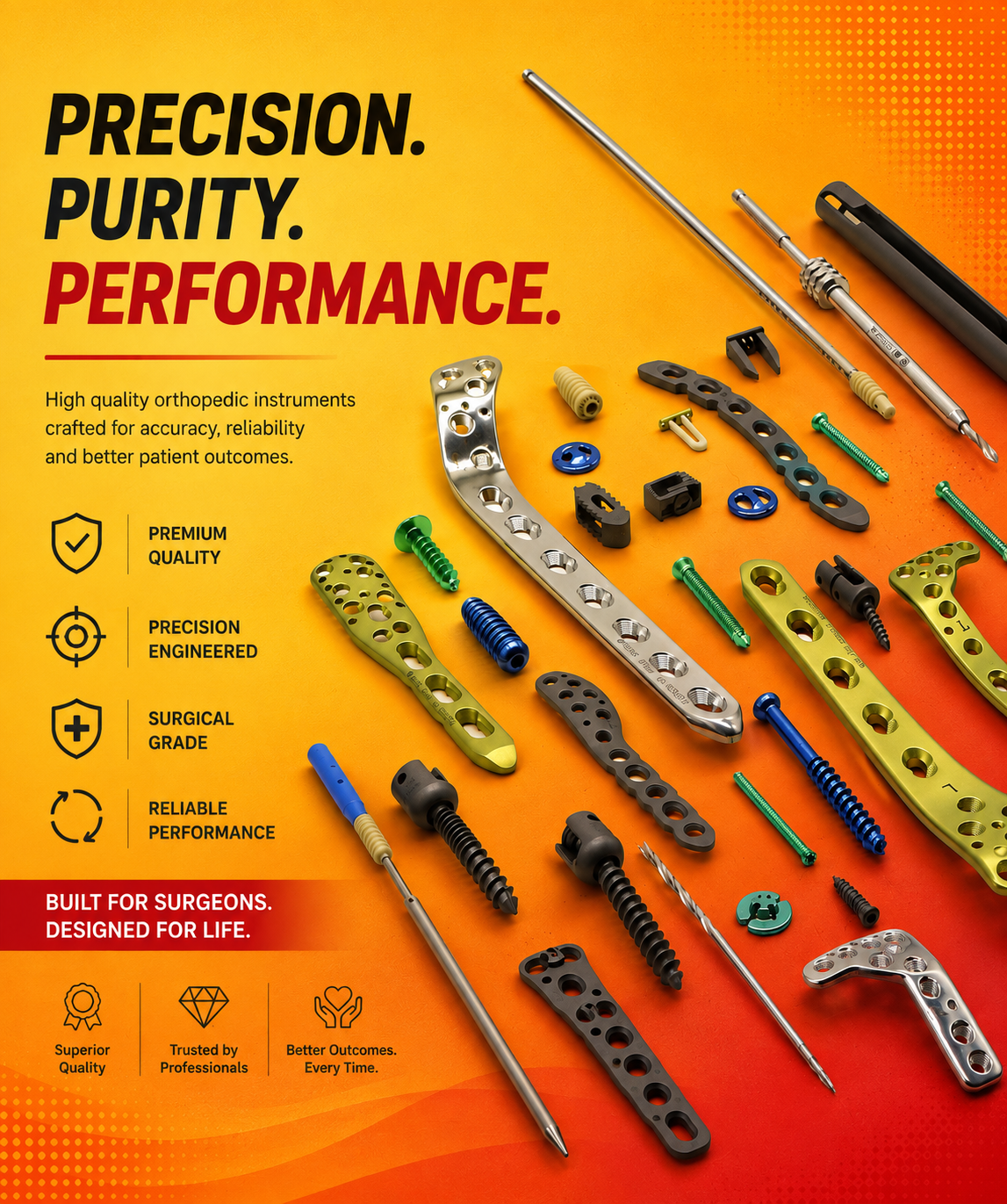
- Bone Plates
- Bone Screws
- Dental Implants
- Spinal Components
- Maxillofacial Implants
Stainless Steel
Certain medical-grade stainless steels are used for specific implant applications because of their mechanical properties and corrosion resistance.
The exact material grade must be selected according to the intended application and applicable standards.
Cobalt-Chromium Alloys
Cobalt-chromium alloys are used in certain orthopedic applications, particularly where high strength and wear resistance are required.
PEEK
Polyether ether ketone (PEEK) is a high-performance polymer used in selected implant applications, including some spinal and orthopedic devices.
Its properties can make it useful for applications requiring a radiolucent or polymer-based implant material.
Surgical Implant Instrument Sets
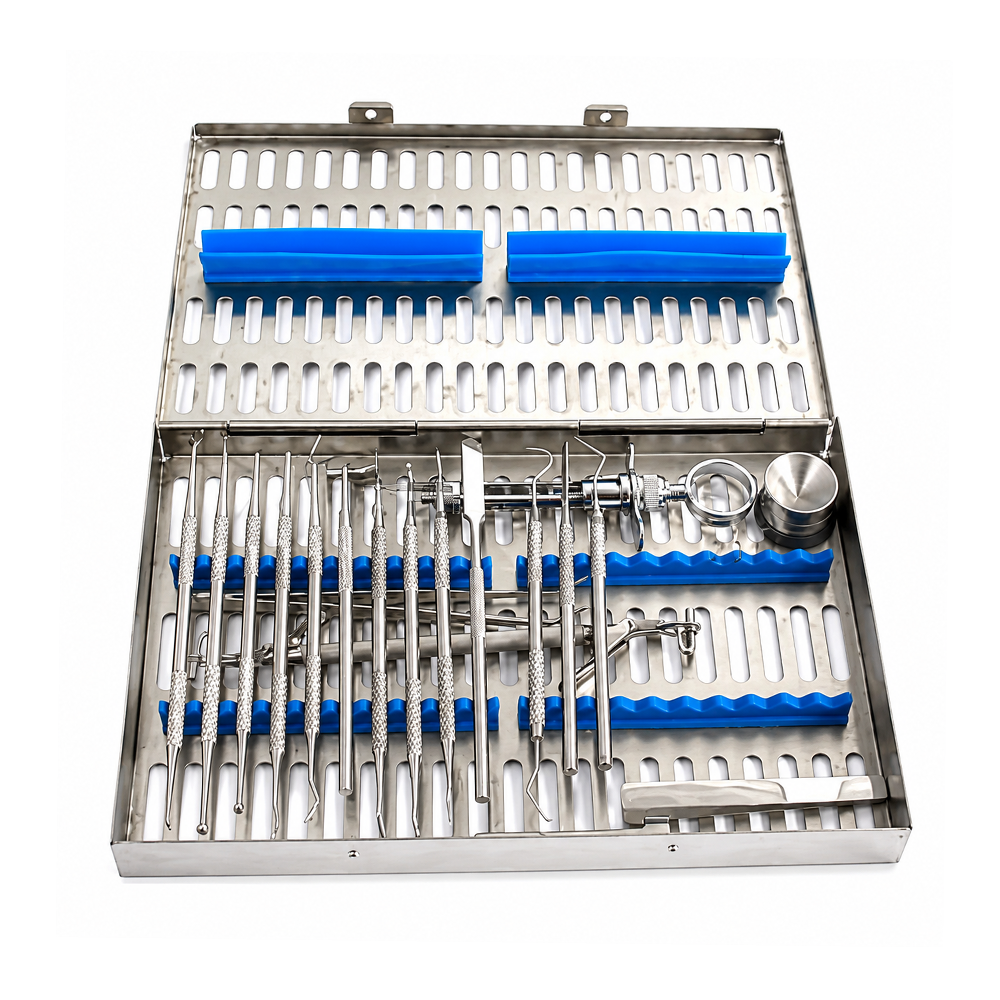
A complete implant instrument set may be organized inside a:
- Sterilization Tray
- Instrument Container
- Surgical Cassette
- Modular Instrument Tray
A well-organized tray can help the surgical team identify instruments efficiently during a procedure.
Instrument trays may include designated positions for:
- Drills
- Screwdrivers
- Gauges
- Forceps
- Retractors
- Reamers
- Implant holders
- Trial components
- Specialized instruments
Quality Control for Surgical Implants
Quality control is critical throughout implant manufacturing.
Typical quality activities may include:
Raw Material Inspection
Materials should be verified against appropriate specifications.
Dimensional Inspection
Critical implant dimensions should be checked using suitable measuring equipment.
Surface Inspection
Products should be inspected for unacceptable surface defects.
Mechanical Testing
Where applicable, implants may undergo mechanical testing appropriate to their design and intended use.
Functional Testing
Components designed to interact with other components should be checked for compatibility and function.
Cleaning
Manufacturing residues should be controlled according to the applicable manufacturing process.
Packaging Inspection
Packaging should be inspected to ensure it meets the defined requirements.
Final Inspection
Finished products should undergo documented final quality checks.
Standards and Regulatory Requirements
Surgical implants are highly regulated products. Requirements vary according to the country, product classification, intended use, and regulatory pathway.
Manufacturers and exporters may need to consider applicable requirements involving:
- Quality management systems
- Risk management
- Biocompatibility
- Sterilization
- Packaging
- Labeling
- Traceability
- Mechanical testing
- Clinical evaluation
- Post-market surveillance
For international markets, manufacturers and importers should identify the specific regulatory requirements applicable to the destination country.
Surgical Implant Manufacturing Process
A typical manufacturing process may involve:
Step 1: Product Design
The implant is designed according to its intended clinical application.
Step 2: Material Selection
A suitable implant-grade material is selected.
Step 3: Precision Manufacturing
The component is manufactured using appropriate machining, forming, finishing, or other production technologies.
Step 4: Surface Treatment
Where required, the implant may undergo a defined surface treatment or finishing process.
Step 5: Cleaning
Manufacturing residues are removed using controlled cleaning processes.
Step 6: Inspection
Critical dimensions and surface characteristics are inspected.
Step 7: Testing
Applicable mechanical, functional, or other tests are performed.
Step 8: Packaging
The finished implant is packaged according to its intended supply condition.
Step 9: Sterilization
If supplied sterile, the product undergoes an appropriate validated sterilization process.
Step 10: Final Release
The product is released according to the manufacturer's quality system and applicable requirements.
Benefits of High-Quality Surgical Implant Systems
A properly designed implant system can provide:
- Reliable mechanical fixation
- Consistent component compatibility
- Improved surgical workflow
- Appropriate anatomical fit
- Controlled implant placement
- Professional instrument organization
- Traceability
- Consistent product quality
However, clinical outcomes depend on many factors, including patient condition, surgical technique, implant selection, postoperative care, and other clinical considerations.
How to Choose a Surgical Implant Supplier
Hospitals, distributors, and surgical professionals should evaluate suppliers based on:
Product Quality
Review material specifications, manufacturing controls, and product documentation.
Regulatory Compliance
Confirm the regulatory status and applicable documentation for the target market.
Manufacturing Capability
Consider the supplier's ability to maintain consistent production quality.
Product Range
A broad product range can simplify sourcing for different procedures.
Instrument Compatibility
For implant systems, confirm that instruments are compatible with the relevant implant components.
Packaging
Evaluate packaging quality and product protection.
Traceability
Proper product identification and traceability are important for regulated surgical products.
Customer Support
Technical documentation and responsive support can be valuable for distributors and healthcare customers.
Surgical Implants for International Export
The international surgical implant market requires attention to quality, documentation, packaging, regulatory requirements, and supply consistency.
For export customers, important information may include:
- Product name
- Catalog number
- Dimensions
- Material
- Implant type
- Sterile/non-sterile status
- Packaging configuration
- Product photographs
- Technical specifications
- Certificates and quality documentation where applicable
- Country-specific regulatory documentation
- Private-label requirements
- Carton specifications
Kellin Industries can support international buyers with surgical instrument and implant-related product solutions according to customer requirements and applicable manufacturing capabilities.
Frequently Asked Questions
What are surgical implants?
Surgical implants are medical devices placed inside or attached to the body to support, replace, stabilize, or restore anatomical structures.
What materials are commonly used for surgical implants?
Common materials include titanium and titanium alloys, selected stainless steels, cobalt-chromium alloys, and PEEK, depending on the intended application.
What are orthopedic implants?
Orthopedic implants are devices used to stabilize, reconstruct, or replace musculoskeletal structures, including plates, screws, nails, joint replacement components, and other fixation systems.
What are trauma implants?
Trauma implants are used to surgically stabilize fractures and injuries. Examples include plates, screws, nails, wires, and pins.
What instruments are used with orthopedic implants?
Depending on the implant system, instruments may include drill guides, drills, screwdrivers, depth gauges, taps, reamers, reduction forceps, plate benders, implant holders, and specialized insertion instruments.
Can surgical implant instruments be sterilized?
Many reusable surgical instruments are designed for cleaning and sterilization, but the exact method must follow the manufacturer's validated instructions.
Are surgical implants supplied sterile?
Some implants are supplied sterile, while others may be supplied non-sterile depending on the product and manufacturer. The product labeling and manufacturer's instructions determine the supplied condition.
Can surgical implant instruments be customized?
Instrument sets can potentially be customized according to the required procedures, implant system, instrument configuration, sizes, packaging, and customer specifications.
Conclusion
Surgical implants play an essential role in modern orthopedic, trauma, spinal, dental, and reconstructive surgery. From bone plates and screws to spinal systems, joint replacement components, dental implants, and maxillofacial fixation systems, each implant is designed for a specific clinical purpose.
The performance of an implant system depends not only on the implant itself but also on material selection, engineering, manufacturing quality, dimensional accuracy, compatible surgical instruments, sterilization, packaging, and appropriate clinical use.
For hospitals, surgeons, distributors, and international buyers, selecting a reliable supplier with appropriate quality systems and technical capabilities is an important part of building a dependable surgical product supply chain.
Kellin Industries provides professional surgical instrument solutions for implant-related procedures, including individual instruments, specialized instrument sets, customized configurations, and export-oriented product requirements.
SURGICAL IMPLANTS
Precision Implant Systems & Surgical Instruments
Kellin Industries









 SURGICAL INSTRUMENTS
 SURGICAL IMPLANTS & INSTRUMENTS
 DENTAL INSTRUMENTS
 DENTAL IMPLANTS
 ELECTROSURGICAL INSTRUMENTS
 BEAUTY INSTRUMENTS
 VETERINARY INSTRUMENTS
 COFFEE TOOLS
 MESH STERILIZATION TRAYS